Showing posts with label Exercise. Show all posts

Get More Out of Your Workouts: Perfect Your Technique

A lot of people miss out on getting the full value from their exercises because of their form - a few simple changes to how your do your exercises can increase muscle growth and strength. 

Squats
A mistake that a lot of people make is trying to bend their legs to crouch down. Instead, try to imagine sitting down on a chair - keep your shins as vertical as possible, and counter the imbalance by leaning your upper body forwards, but keep your body straight and your abs engaged throughout the exercise. When you come up. pop your hips forwards to complete the exercise. Look straight ahead throughout the exercise.

Lunges
A lot of people transfer the idea of squats and leaning forward to lunges, which is a mistake. Keep your front heel down, and do not lean your body forwards over your knee. You should not be able to see your front foot. Keep your body straight and vertical, and your abs engaged. Try not to rest your hands on your thigh, and look ahead throughout the exercise. The motion of the back leg should be a controlled bend, not just sagging down.

Push Ups
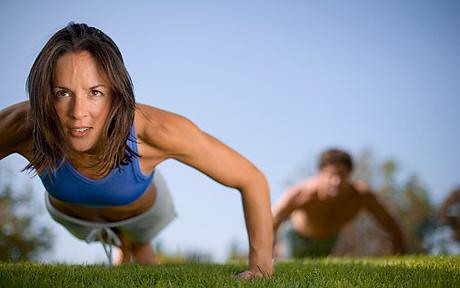
Instead of simply concentrating in moving up and down, you can improve this exercise by adding a little push to the end to increase the shoulder and back workout. After you've bent your arms, and when you've straightened them back out, try to push your upper back towards the ceiling a little more. Ensure that it is a slow and controlled push. So the movment is not simply up-down, it is up-push further up-down.

For more ways to make your exercise more effective, check out 5 virtually instant ways to improve you workout.


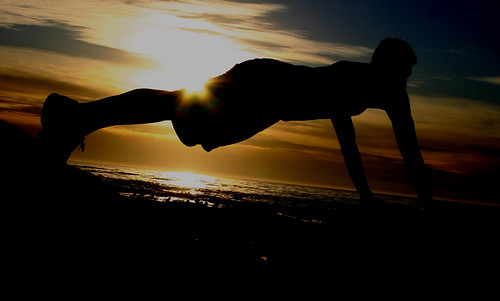
Thank you to Yelkaim for the image.

Stretching

Stretching is an incredibly important part of exercise, and something that you should do regularly throughout your life as it helps minimise muscle tightening and restricted range of movement as you age. Stretching not only increases your flexibility and reduces the risk of injury - it also reduces muscle tension, helps circulation and increases energy levels.

Always warm up and stretch before undertaking any exercise, but it's also a good idea to stretch regularly even if you are not exercising. You naturally get the urge to stretch in mornings or when you're tired - why not simply do a range of stretches that work your entire body, instead of just your spine?

How to stretch safely
  • Do not bounce in your stretch
  • Make sure that increasing your stretch is a gradual movement
  • Take breaks between stretches; do one stretch, then move to another, and go back to the original one again. You should be able to stretch further than the first time you did the exercise.
  • Exhale when pushing further into the stretch
  • A stretching/burning pain in your muscles is ok, but if you start getting a sharp pain or any pain around your joints, stop immediately
  • Don't force your body to go too far - stretching involves pushing your body a little bit each day. Do not get frustrated and end up injuring yourself. 
Different stretches 

This diagram shows a range of stretches for your whole body.


 1) Chest: Clasp your hands behind your back and hold them to pull your chest apart. Raise your hands up (still clasped) as far as you can.
2) Upper back: Clasp your hands on front of you and keep your arms straight, raise your hands up to chest height and pull your shoulder blades apart.
3) Triceps: bend one arm and put it down the middle of your back. Either push near the elbow (not on) with the other arm, or bring it up the back and try to join your hands.
4) Calves: Stand in the lunge position - instead of bending the back leg, keep it straight with the heel on the floor.
5) Hamstring: Either lie on your back with your legs bend, and raise and straighten one leg, pulling it towards your chest with your arms (keeping it straight), or stay standing and put one straight leg on a chair (heel on the chair) and push down a little).
6) Quads: Stand up and bend one leg - using your hands, pull it up and towards your body. Keep your knees together.If you have balance problems, you can do this lying down.
7) Outer thigh: Lie on your back, with both legs bent and in the air. Cross your legs over, using the upper leg to push the lower leg to the opposite side.
8) Inner thigh: Stand with your legs just over shoulder-width apart. Bring your bodyweight over one foot by bending the leg, which stretches the opposite thigh.
9) Inner thighs: Lie on your back, bend your legs and bring your feet together, letting your legs fall apart. You may want to push a little near your knees (not on)
10) Lower back: Either lie on your back with your legs bent and let your lets fall to one side, and keep your shoulders flat on the floor and point your hands in the opposite direction to your legs, or lie on your back, bend your legs and clasp your hands behind your legs (you can do this with both legs together, or one by one).
11) Torso and quads: Sit up straight with your legs out straight in front of you. Bend one leg and bring it over the other. Look over the other shoulder, and use the opposite arm to the leg push it further across.

Make sure that you stretch both sides equally, and do not push on joints.

Do you have any other stretches that you do regularly?

Exercise Helps You Regenerate Brain Cells!

The Cell Transplantation Journal recently published a study that shows that brain cells do in fact regrow! Despite past claims (mostly up to the 60's), researchers in Hong Kong have found that brain cell regeneration does happen, and it plays a key part in reducing stress. They're also found that exercise is the key factor in brain cell regeneration (neurogenesis) - in fact, it activates the process.

Dr Kwok-Fai from Hong Kong said "Research has shown that exercise can improve mood and cognition and has also demonstrated that a deficit in adult neurogenesis may result in depressive disorders." His team's research  looked at exercise as a means of combating stress and the idea that exercise promotes neurogenesis.

The effect of stress and depression on the brain is astounding; in severe cases, it impacts part of the brain called the hippocampus (part of the brain that is involved in memory and emotional regulation). It can actually go as far as shrinking that part of the brain, eliminating the possibility of brain cell regeneration.

Regular exercise helps the hippocampus  mend damaged brain cells and grow neurons by maintaining 'plasticity' - the new neurons tend to enhance mood, maternal behaviour and reproductive function. 

This study reinforces the message that exercise is an essential part of a healthy lifestyle - both physically, and mentally.


Thanks to Liz Henry for the image.

5 Virtually Instant Ways to Improve Your Work Out


Very few people get the most out of the workouts - it only takes a few minor adjustments to how you train, and how you follow up your training to ensure that you are maximising the benefits of your work outs sessions, and that you are taking good care of your body.

1) Breathe Properly
Don't hold your breath while you're working out - to get the most out of your exercises take full breaths and breathe out when exerting (or hitting), and breathe in on the release. Learn to take full, complete breaths (by breathing from the diaphragm rather than just the top of your chest). This will help you to get the most oxygen possible to your muscles, and will improve your performance. Sensei Jim will tell you exhale when you are hitting, and will show you how to breathe properly when training - we'll be posting more on this subject soon.


2) Lose the Shoes
There are quite a few reasons we train barefoot in the dojo, and it can help you when working out in the gym/at home too. Removing your shoes creates more instability, which challenges the muscles in your feet and legs more, making you burn more calories during your work out. This can also increase your range of motion.

3) Add to Your Range of Motion
This makes each exercise harder, so that you gain more from every push up, sit up, dorsal raise, tricep dip... If sit ups don't challenge you enough, slip a folded towel under the small of your back to increase the range of motion. If push ups are getting easy, raise your hands off the floor so that you can dip lower with each one. There aren't many exercises that you can't 'improve' this way - you need to constantly push and challenge yourself if you want to continue to improve.


4) Don't Let Yourself Stay in Your Comfort Zone
Most people are guilty of doing this at least once - instead of pushing further and harder, it's easy to just do what you know you can and let your fitness plateau. Don't let yourself stay in your comfort zone! I'll take push ups for example - you can make them harder by pressing your elbows tight against the body, by moving your hands closer to the middle, by doing them on one hand, by jumping up and clapping between push ups. There is no reason to let yourself do exercises that you no longer find challenging - it's counterproductive, and will often mean that you'll start getting bored because it's too easy. Always go a little out of your comfort zone - a harder push up, a higher kick, a stretch that goes a little further than last time - and you will always improve.


5) Eat Properly Before and After Your Work Out
Paying close attention to your pre and post work out meals will help you achieve your body and fitness goals faster - whether you want to lose weight, add muscle or build strength. Ideally, you should eat quality carbs within 30 mins of your workout, and protein no later than 90 mins afterwards. The recommended carb to protein ratio for post workout meals is 4:1. Chicken, fish, egg whites, bananas, yoghurt are all good additions to a post workout meal or snack.  The next blog post will look at 4 ways you can add bananas to a snack or meal!


Thanks to SkinnyGuyWorkoutPlan for the image.

10 Minute Work out (4)

Here's the last in this series of 10 minute work outs. This one is slightly different to the rest - you will exercise for 1 minute (flat out) and then rest for 30 seconds and  repeat that 6 times. As always, remember to stretch out and warm up properly.

First Exercise: Bicycle Sit Ups
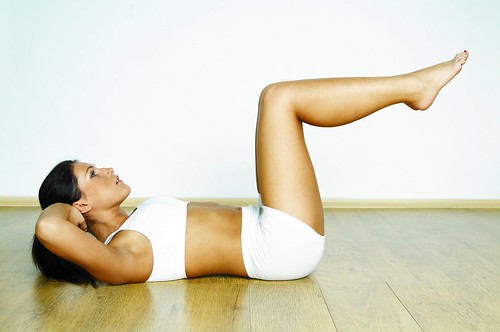
Lie on your back, and raise your feet about 6 inches off the floor - keep them raised throughout the exercise. Hold your hands at your temples with your elbows wide out. Lift yourself up into the sitting position, while twisting your body slightly and bending one knee until your elbow touches the opposite knee. Then go back down into the original position and repeat with the opposite side.

(This exercise was also featured in our previous post 5 Simple Exercises to Better Abs) 


Second Exercise: Squats
Stand with your feet facing forwards, roughly shoulder-width apart. Put your hands behind your head and bend your knees slowly (with your heels flat on the floor) until your thighs are parallel to the floor, then straighten your legs. Ensure that you continue this in a smooth motion, not to damage your knees.


Third Exercise: Crunches
Lie on your back with your knees slightly bent and raise your shoulder blades off the floor. Lift yourself another 4 inches towards your knees and then lower back to your original position. The idea is to do the 'middle' part of the sit up without fully sitting up or lying down, and to keep your abs engaged throughout. Pulse up and down to maintain continuous movement throughout the one minute.


Fourth Exercise: Plank
Hold the push up position (the plank) for one minute. Do not let your body sag or arch, and don't drop your knees to the floor.


Fifth Exercise: Monkey Push Ups
Put your feet together and sit upright on your heels with your knees apart. Then, put your hands on the floor in front of you (with your arms in between your knees) and bend your elbows to press down and push all the way back up to the original sitting position. The push up itself will need some speed to get you back to the original positions.

(This exercise was also featured in our previous post Push Up Masterclass)


Sixth Exercise: Dorsal Raise
Lie on your front with your legs straight and your hands behind your head. Without moving the bottom half of your body, and without putting your hands down, raise your chest off the floor (as far as you can). Lower and repeat.


Final Minute: Squat Jogs
Stand on your hands and feet, bent at the waist - ensure that you have enough weight on your hands to prevent you slipping before you starrt the exercise. Bring one foot forwards and then push it back again - repeat with the other leg and continue so that you are jogging your legs, but balancing some of your weight on your hands as you do it.


Hope you enjoyed this series! Let us know what you thought, and if you'd like more of these 10 minute work outs.

In case you missed the first 3:
10 minute workout 1
10 minute workout 2
10 minute workout 3

10 Minute Workout (3)


Here's the latest in our series of 10 minute workouts! As always, remember to warm up and stretch out to ensure that you don't pull any muscles. Unlike the previous work outs, you will do a circuit of exercises instead of doing a single exercise and then moving onto the next.

16 x Push Ups with Cross Kicks

Get into the push up position and do a complete push up. Before you repeat, lift one foot off the floor and kick (slow and controlled) across to the opposite side (so you kick left with your right leg, and right with your left leg so your kicks go under your body). Make sure that your hips stay as low as possible, and you are not twisting your body or dragging your foot on the floor. It may be easier to take one hand off the floor when doing this.

After the kick, bend the  knee  on the same leg and bring it to the elbow on the same side (right knee to right elbow), then return to original push up position and then repeat the push up and the leg movement on the other side. Alternate with each push up, and ensure that you're breathing in time with the exercise (out when you push up and when  your leg moves across).

This is an extension of one of the exercises featured in 5 Simple Exercises to Better Abs.

10 x Rolling Push Ups

Stay in the push up position. Instead of simply moving up and down in a straight line, you will be moving your chest in a circle (from left, down, right and up again). So move your body weight to your left and then bend your arms down - stay down and bring your chest to the centre, and move to your right. Once your body weight is over to the right, push yourself up and then return to centre. Once complete circle is a push up. Ensure that you're doing slow, controlled movements and are doing a full push up to get the maximum benefit from this exercise.

16 x Lunges

Stand up straight with your arms down by your sides. Take a step forward and bend the front knee so that your back knee also bends towards the floor - stop when the front knee is at 90 degrees. Straighten, and return to the original position to repeat with the other leg. Repeat 16 times.


Repeat this set of exercises 4 times.


The next 10 minute work out will be the last in this series - hope you enjoyed them! If you missed the last two 10 minute workouts, you can find them here and here.

To get workouts, technique tips and diets in your inbox, subscribe using the feedburner box on the top right of this page.  

10 Minute Workout (1)


Here's the first in a series of 10 minute work outs. These workouts are intense, and you won't need any equipment that you don't already have in the house (so you might occasionally need a chair or a door!). In addition to the tabata training , these are a great way to get a quick workout in on non-training days.

So here it is:

Warm up and stretch prior to exercising. Ensure that you do stretching before and after the work out to avoid injury and keep your muscles supple.

30 x hamstring raises on a chair
Lie on the floor with your feet up on a chair. Raise your body (keep your arms by your sides) so that the soles of your feet are flat on the seat of the chair, then slowly push down with your feet and arch your back until you're supported by your feet and your shoulders. Make sure all of your movements are slow and controlled to avoid injury and to get the most out of this exercise. If you want to make it harder, rest the heels of your feet on the chair instead of the whole sole of the foot. Do the 30 in 3 sets of 10 - make sure you're constantly moving throughout the reps and are engaging your glutes and abs throughout.

60 x obligue crunches
Lie on your side with your legs bent slightly. Put your hands either side of your head with your fingertips touching your temples, and raise your shoulder off the floor as high as you can, ensuring that it's a smooth, controlled movement throughout. Do 30 on each side, in 3 sets of 10.

30 x rotating push up
Get into the standard push up position and bend your arms until your chest and nose are as close to the floor as you can get them, while keeping your body straight, and then push up (completing a standard push up). While you're up in push up position, extend one hand out to your side and then twist so that it is pointing up at the ceiling, while still at a 90 degree angle from your body. Once you've done that, resume press up position and repeat on the other side. Repeat 30 times in 3 sets of 10.

60 x walking lunges
Step forward with your right foot into a lunge position (with your right knee behind your right foot, back straight, toes pointing straight ahead). Then step forwards with your left foot so that you're in the lunge position with your left leg in front. The aim of this exercise is to walk without letting your legs straighten out (therefore performing lunges). When you take a step forwards, make sure that you're bending both knees and that your knee is pointing towards your big toe. Don't let your knees extend beyond your feet. Repeat 60 times in 3 sets of 20 reps.

Thanks to DFMillington for the image. 

Be a Better Kickboxer in 10 Minutes a Day


To really excel at a sport, you can't just turn up to training once a week and forget about it for the rest of the time. To truely become a master of it, rather than someone that 'goes kickboxing' you need to dedicate yourself to it. That doesn't mean hours of training every single day, and it doesn't mean that it needs to be in your thoughts constantly - you need to rest, and you need to do other things! However, a small amount of daily exercise can help you push yourself further in your training sessions and help you progress faster - whether that's getting your kicks higher, moving faster when sparring or being able to train harder right through to the last minutes of the lesson.

Stretching (2 mins a day)

Kickboxers aren't just strong and fast - you need to be flexible too, otherwise you'll never get your kicks up above the belt. Stretching before bed or during an ad break on tv won't make a huge difference after a day or two, but in a month or two you'll notice that your kicks are getting higher and your body is more supple.


Tabata (4 mins a day)

You've probably read the last post in December on how tabata training can help lose weight and stay in shape. It's quick, but by no means easy. Choose an exercise you need to improve on (such as push ups) and just work on that for a few minutes a day. You'll be amazed at the results.

That Extra Bit (4 mins a day)

This is the easiest part since you don't need to 'set aside' any time to do it. Take the stairs instead of the lift, walk to the next bus or tube stop, walk to the corner shop instead of hopping in the car - basically, take advantage of the daily opportunities to get a bit more exercise.

7 Exercises to Improve Your Kicks

A decent kick requires a combination of flexibility, balance and strength. This combination of exercises works on all three to help you kick higher, harder and land safely and ready to throw the next technique.

1. Lateral Stretch

Probably the simplest, but also the most difficult. If you really want to improve your flexibility, you need to stretch every day and push yourself that little bit further each time. With the lateral stretch, simply stand with your feet as far apart as possible and hold your weight there - use your bodyweight to push your legs further apart, and your leg muscles to stop yourself from going further than you're comfortable with.

2. Lunge

A fantastic exercise for building strength - put one leg in front and the other behind with both feet facing forwards. Bend the front knee to at least a 90 degree angle and leg the leg behind drop down, keeping it straight. Go as far down as you can while supporting your weight with your legs. You can either do this as a static exercise, or do sets of lunges.

3. Squat

Stand with your legs shoulder-width apart and bend your knees at a 90 degree angle - ensure that your heels stay on the floor during the exercise. Like the lunge, you can either hold the position or do sets.

4. Leg Lifts

Stand on your hands and knees, keeping your back straight and flat. Raise one of your legs until it is at the same level as your body - don't let it dip lower than that at any point during the set - and lift and lower it for as many reps as you want per set. The key to this exercise is keeping your abs engaged, your back straight and making sure that your leg doesn't dip down too far.

5. Balancing

Like the lateral stretch, this is a fairly simple exercise that is quite difficult for a lot of beginners, Stand up straight, and lift your leg (keeping it straight) until it's at 90 degrees from your body (you need to be able to kick above waist height in kickboxing). As you're lifting your leg, let your body bend to the opposite side so it ends up in line with your leg - it will act as a counter-weight and keep you balanced. Unlike the squats and lunges, the point to this exercise isn't to strengthen your muscles, but to help you balance and teach you how to use your own body weight to help you lift your legs higher and stay balanced. It's a good idea to experiment with how high you can lift your leg and stay balanced. Make sure all your movements are slow and fluid, and your supporting foot is steady.

6. Multiple Kicks

Use a chair or table to balance for this one if you're not confident enough to kick without. These kicks don't need to be very fast, so take your time with them. Do a series of kicks without lowering your foot - to start with, try a waist-height front kick, roundhouse kick, chest-height front kick and then a side kick, and then lower your foot. Push yourself to kick higher each time, and ensure that you clearly show which part of your foot you are striking with.

7. Leg Swing

While holding on to a chair/table/door handle, keep your legs straight and swing one of your legs sideways away from your body as high as you can. Repeat this 20 times on each leg - you should go higher at the end than you do at the beginning.


Ultimate Kickboxing - North London

Push Up Masterclass - 5 Push Ups You Should Add to Your Routine


We've put together this Push Up Masterclass for those of you doing the Push Up Challenge, and everyone else that just wants to add some variety to their work outs and train different muscle groups. While the basic idea is the same (rest on your hands and feet and lift your own bodyweight), these exercises put more strain on different muscle groups.


The Classic

We all know this one - hands shoulder-width apart, legs and body straight with your feet together. There are quite a few variations on this if standard push ups are getting easy or if you want a change:
- Press your elbows against your sides
- Move your hands closer to the centre
- Only rest on one leg

Once you can do all of those, it may be time to try one-handed press ups. See the exercise below if you prefer to build up to it!


Monkey Push Up

Put your feet together and sit upright on your heels with your knees apart. Then, put your hands on the floor in front of you (with your arms in between your knees) and bend your elbows to press down and push all the way back up to the original sitting position. The push up itself will need some speed to get you back to the original positions.


Shoulder Push Up

This is something that a lot of beginners tend to do, which (ironically) is actually harder than the Classic push up. Start off in Classic position, but bend your body at the hips at a 90-100 degree angle (it may be easier to do this with your feet apart). Press down and push up, keeping the bend in your body and your legs straight. This push up is fantastic for your shoulders.


Lizard Push Up


This push up involves walking forwards, so ensure you have enough room to do so. Start in the Classic position, and move your right hand and your left leg forwards (bend the leg outwards to do so, but ensure that your foot is just going forwards), move forwards into your new position and press down with your right leg still outstretched and your left hand still lower down (so you haven't 'finished' the step yet), push up, then move the other hand and foot forwards and repeat. If you have trouble, just imagine a lizard walking.

One-Handed Push Up

One-Handed Push Ups are generally the preserve of the incredibly strong and balanced, but there is a good way to work up to them. Start in the Classic position, but put your knees on the floor and slightly apart - bend your knees at 90 degrees. Put one hand on your hip, and the other in the centre in front of you, press down and push up. Always ensure that you do equal amounts on both hands.


Always stretch and warm up properly before exercising, even if you are only doing a few push ups!


If you want to build your strength and stability, and incorporate new exercises into your workouts, visit one of our classes. More information can be found on http://www.ultimatekickboxing.co.uk/ .

Push ups


If you're serious about increasing strength and endurance, push ups are a fantastic way to help. A lot of students have trouble performing press ups when they start, but with consistent training, they're fairly easy to learn.

If you train for 3 days a week, for 6 weeks, most people will be able to work up to doing 50-100 consecutive press ups. The most important part is to maintain good form - sagging bodies and half-press ups will not help you build strength - and to exercise often.

This work out is based on a person being able to perform 10-20 good, consecutive press ups.

Week 1:
For days 1 and 2, do a 10 min warm up (try our tabata warm up to do it in 4 if you're short of time) and then complete 5 sets of push ups.
Set 1 - 10
Set 2 - 12
Set 3 - 7
Set 4 - 7
Set 5 - as many as you can do (at least 12)

On day 3, add 2 push ups to each set.

Week 2:
With week 1 behind you, you've alread started building strength and increasing your endurance. Throughout the 6 weeks, ensure that you're maintaining good form, but don't hesitate if you need to take slightly longer breaks in between sets.

For days 1 and 2, warm up again and complete the following sets:
Set 1: 14
Set 2: 16
Set 3: 12
Set 4: 12
Set 5: as many as you can (at least 17)

On day 3, add 3 to each set again.

Week 3:
Half way! By this point you should be feeling a difference. Don't slip up though, and make sure that you are doing 5 sets 3 times a week.

On days 1 and 2, warm up again:
Set 1: 20
Set 2: 25
Set 3: 15
Set 4: 15
Set 5: as many as you can (at least 25)

On day 3, increase the set values:
Set 1; 22
Set 2: 30
Set 3: 20
Set 4: 20
Set 5: as many as you can (at least 28)

Week 4:
Week 4 is where you begin to really push yourself every single day - unlike the first 3 weeks, the set values increase every day.

Day 1:
Set 1: 21
Set 2: 25
Set 3: 21
Set 4: 21
Set 5: as many as you can (at least 32)

Day 2:
Set 1: 25
Set 2: 29
Set 3: 25
Set 4: 25
Set 5: as many as you can (at least 36)

Day 3:
Set 1: 29
Set 2: 33
Set 3: 29
Set 4: 29
Set 5: as many as you can (at least 40)

Week 5:
To continue pushing yourself, now we've increased the number of sets but decreased the set values slightly - you'll be able to do more press ups but over a slightly longer period, with more rest.

On day 1 and 2, complete the following sets:
Set 1: 19
Set 2: 29
Set 3: 22
Set 4: 22
Set 5: 18
Set 6: 18
Set 7: 22
Set 8: as many as you can (try for at least 50)

On day 3, increase all the set values by 2.

Week 6:
We've included a total structure change on week 6, which will take you up to 100 press ups with breaks in between the sets.

Increase the number of press ups by 1 in each set, until you're at 10, and then work back down. Your set values will be 1,2,3,4,5,6,7,8,9,10,9,8,7,6,5,4,3,2,1. However, by this point and due to the new values, you should be taking much shorter breaks. Try doing the same number of sit ups instead of resting.

Congratulations - if you just did that, you just completed 100 press ups. Why not test yourself on day 4 of week 6 to see if you're up to 100?

And if you need inspiration, have a look at this guy. 

5 Simple Exercises to Better Abs


A lot of people complain that, even when they do hundreds of sit-ups a day, they don't have a flat stomach or defined abs. Unfortunately, simply doing sit ups won't give you a flat stomach (in fact, it will develop some parts of it and not others, making the muscles less even). However, these simple exercises, when combined, will exercise all parts of your stomach.

1. The Plank
This is a fairly simple, static exercise, which works your entire core. Essentially, you need to get into the press-up position - keep your arms shoulder-width apart and your body straight, with your feet together and support your body weight on your hands and feet.

Hold this position for 3 minutes. If you feel like you are starting to ache or need to move in that time, either do a few press-ups, while keeping the abdominals engaged, or move onto your elbows instead of your hands.

Always ensure that you are pushing yourself, even with static exercises - if it becomes easy, hold it for longer, or move your hands closer into the center, or balance on one leg.

2. Bicycle sit-ups
Lie on your back, and raise your feet about 6 inches off the floor - keep them raised throughout the exercise. Hold your hands at your temples with your elbows wide out. Lift yourself up into the sitting position, while twisting your body slightly and bending one knee until your elbow touches the opposite knee. Then go back down into the original position and repeat with the opposite side.

This is a fantastic move that works more of your muscles than a conventional sit-up. A great way to do this exercise (if you're sick of counting) is to incorporate it into your tabata routine (in a previous post).

3. The Bridge
Another static exercise, like the Plank, but this is on your side. You still need to keep your body as straight as possible, but you will be balancing on one hand rather than two. Start by lying on your side with your supporting elbow bent at a right-angle. Slowly raise your body until it's perfectly straight rather than sagging down to lie on the ground, and hold it straight for 2 minutes on each side.

Again, if this becomes easy as you strengthen your muscles, you can make it more challenging by supporting yourself on your hand rather than your elbow, or raising your other arm up above you.


4. Leg Raises
Lie on your back, with your hands under the small of your back. Slowly raise your legs until they're at a 30-40 degree angle from the floor and hold them there for the count of 20 and lower them until they are a few inches off the floor, and then repeat.


5. Plank with cross kicks
Get into the plank position like in number 1. Rather than just holding this position, lift one foot off the floor and kick (slow and controlled) across to the opposite side (so you kick left with your right leg, and right with your left leg so your kicks go under your body). Make sure that your hips stay as low as possible, and you are not twisting your body or dragging your foot on the floor. It may be easier to take one hand off the floor when doing this.

After the kick, bend the  knee  on the same leg and bring it to the elbow on the same side (right knee to right elbow), then return to original position and repeat on other side.


These exercises will build and tone your muscles, but good abs aren't built on exercise alone - you need to watch what you eat to ensure your fantastic abs aren't hidden by a thick layer of fat. The forumula for healthy adults is fairly simple - eat the same amount of calories as you use up if you want to stay at the same weight, and eat fewer calories than you use if you want to lose weight. Ensure that your calories are from quality food, rather than junk (so eating 1300 calories a day, but only from McDonalds, isn't doing you any favours). There are a few extra tricks to help you along though:
  • Drink plenty of water 
  • Eat small amounts regularly - instead of 3 large meals a day, eat 6 smaller ones, more evenly spaced. This will help with your metabolic rate, but try to have your last meal no later than 8pm.
  • Eat high-protein foods, such as nuts (be careful though - there are more calories in these than you think), beans, porridge, eggs and lean meats. Peanut butter is good for staving off sugar-cravings.
  • Drink less alcohol
  • And finally - don't totally obsess over your food! It sounds counter-intuitive, but the more focussed you are on everything you put into your mouth, the more likely you'll break what you see as a 'diet' rather than just eating healthily. If you really really want a piece of chocolate cake, eat it! Just make sure your working off what you eat. 

For more information on our varied, exciting work outs in a friendly environment, visit http://www.ultimatekickboxing.co.uk/

Thanks to Joey Camps for the image. 

Stay in shape over the holidays, in 4 minutes a day!


Even the most dedicated athletes can lapse over the holidays - plenty of food and drink, coupled with the cold weather and celebrations tend to put work outs on a back burner. which means we gain weight and it's harder to get back into a good routine.

Even if you don't head to the gym or train over the holiday period, you can still keep your fitness levels up and avoid piling on the pounds by exercising frequently. The work out detailed in this blog is favoured by a lot of athletes and martial artists, and will only take 4 minutes out of your day to do (you can do it in an ad break, while you're making a cup of tea, just before you go to bed...). You don't even need any equipment.

Tabata training is 4 minutes of interval training/cardio - you don't need to run or jump, you can do any exercise, as long as it involves as many muscle groups as possible.

A tabata workout is simple: you exercise for 20 seconds and rest for 10, and do 8 rounds. Sounds easy ;)

If you don't have a timer at home, there are plenty on the internet. 

Ideas for exercises to do for the 20 seconds:
- press ups
- squat jogs
- lunges
- tuck jumps
- v-sits
- leg raises
- tricep dips
- sit ups
...it can be adapted to any exercise. If you have a cross trainer at home, or like to go jogging, try it on those.

Remember that you do need to work for 8 rounds - it's a good idea to pace yourself a little on the first go to make sure that you keep going through all 8, and push yourself a little harder each time. 


At Southgate Kickboxing Academy, we always strive to improve the fitness, stength and flexibility of our students. Interval training is a fantastic way to push your fitness levels further and build strength quickly. For information on classes, visit http://www.ultimatekickboxing.co.uk/